Public sector · Medium-high stakes
Municipal Benefits Navigator
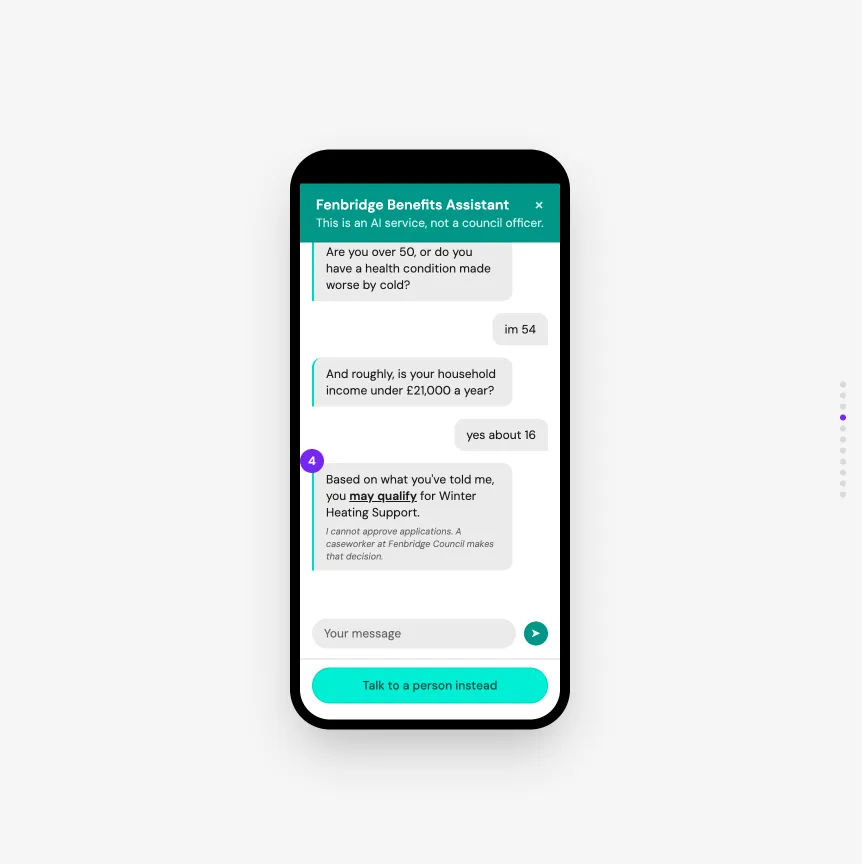
One resident, two AI systems, two different EU AI Act deadlines, and an interface that has to keep the boundary between them visible.
I’m researching how to make AI decisions understandable, trustworthy and actionable for the people they affect. With the help of AI, I curate a library of design patterns and test them in design Explorations.
Public sector · Medium-high stakes
One resident, two AI systems, two different EU AI Act deadlines, and an interface that has to keep the boundary between them visible.
Why this project
Model-level methods like SHAP or LIME help data scientists trace a score back to its inputs. That work is necessary, but it rarely reaches the person affected by the decision. They ask something else: why did this happen, and what can I do? Answering that is a design problem.
The law now requires parts of that answer. Lawyers interpret the obligations and engineers build the models, but the interface where people meet the decision is rarely designed with explainability in mind. That is the gap I’m exploring.
AI helps me research, draft and structure the patterns and Explorations. I am checking the results against primary sources and my own design judgment. Using AI to study how AI should explain itself is part of the experiment: I learn its strengths and limits first hand.
Design Patterns
Each pattern answers a recurring question about an AI decision, not with a UI component, but with the reasoning behind one. The library is organized around four questions: Can I understand it? Can I judge it? Can I act on it? Who is accountable for it?
Patterns that help people grasp what an AI system did and why.
Patterns that help people decide how far to trust an AI result.
Patterns that let people question, correct, or override an AI decision.
Patterns that make AI systems transparent and accountable, to the people using them and to regulators.
EU AI Act
The EU AI Act turns parts of this problem into law, on two clocks. Disclosure comes first: since 2 August 2026, people must be told when they are interacting with an AI system. Explanation and oversight follow: from 2 December 2027, high-risk systems in areas like credit, employment and public benefits need human oversight, record-keeping, clear instructions for deployers, and a right to an explanation for people affected by a decision.
People must be told when they interact with an AI system, and AI-generated content must be marked.
Today ,
Systems already on the market before August 2026 must now embed machine-readable markers in AI-generated content.
Rules apply to high-risk systems listed in Annex III, such as credit scoring, hiring and access to public benefits.
Rules apply to AI embedded in regulated physical products listed in Annex I, such as machinery, toys and lifts.

I’m Christian Laesser, an interface and data visualization designer based in Austria. For more than 15 years I’ve made complex systems legible for institutions like WHO, the World Bank, UNESCO and Deutsche Bahn.
Now I’m looking for teams who develop or deploy AI systems and want to test these patterns on a real product. Maybe you need your interface ready for the EU AI Act, or you simply want people to understand your system’s decisions. Either way, let’s talk.